In an increasingly hectic and busy digital working world, it seems that everything has become urgent.
Emails, meetings, deadlines, projects, problems to be solved-every task seems to have top priority.
Customers want everything and now, the manager sets deadlines “for yesterday,” marketing pushes, sales sells the nonexistent, and the poor digital worker slaves away at multitasking (which I’d like to remind does not exist, not even in computing if one looks in detail how a CPU operates).
So we all agree that this chaotic approach can cause more problems than solutions, making it difficult to focus on what is really urgent.
Urgency becomes a kind of mental state that prevents us from objectively assessing situations and identifying priorities. We feel compelled to respond to every request immediately, even if it is not really important, and this can lead to a loss of valuable focus time.
Incidentally, in many cases, urgency becomes just a way to get attention and make the person requesting it feel more important.
This attitude not only creates confusion and unnecessary stress, but also causes one to focus on things that may not really be important.
This is why I like to say that when everything is urgent, then nothing is urgent.
I have a method I use to reduce some of the impact of this permanent urgency to turn it into priority, let’s see which one.
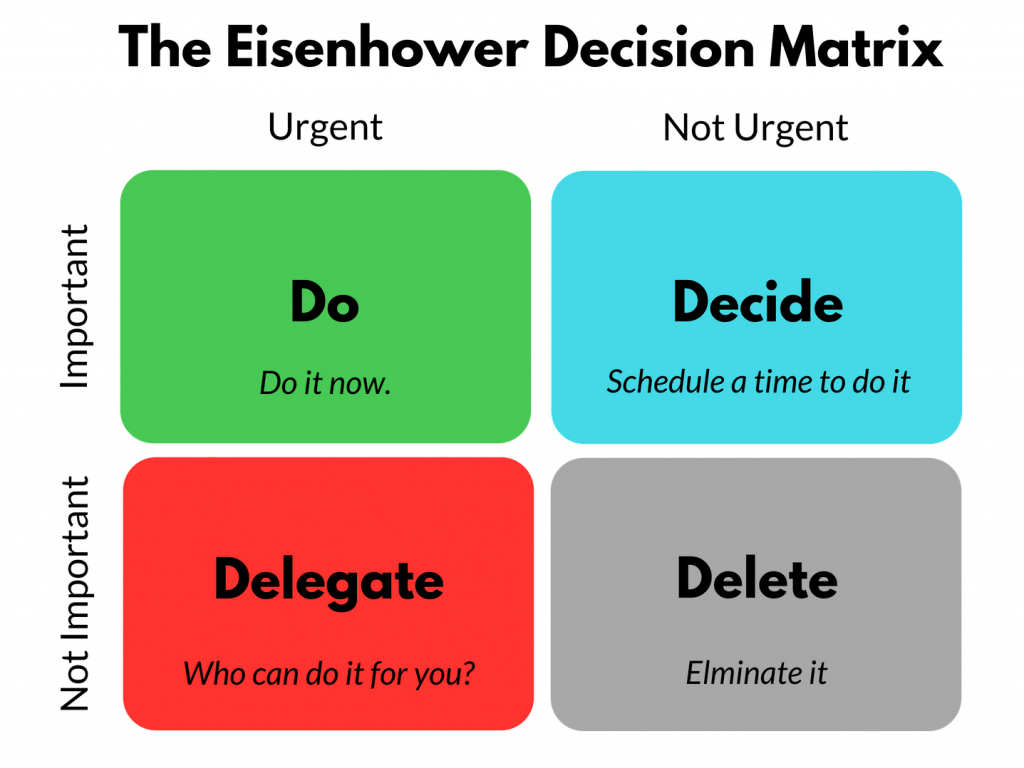
The important/urgent matrix or Eisenhower matrix is a rather useful framework for managing one’s time and activities more efficiently. I now apply it almost subconsciously when I review a task.
If it is both important and urgent, it should be done right away. If it is urgent but not important, it should be delegated. If it is important but not urgent, it should be planned. If it is neither urgent nor important, it should be discarded.
With this filter, one can make one’s life infinitely easier, just by getting into the right mindset to apply it, “detaching” oneself from the more emotional side of the work.
Lately, having taken the reins of KubeLab as CTO, and I have realized how important it is that everyone collaborates to define what is really important and urgent.
Using the important/urgent matrix facilitate time management, improves efficiency, reduces stress and increases productivity. This improves the quality of work and the satisfaction for getting things done.
What?!
You think that your business may need some help in solving some urgencies thus lifting your burdens and solving your headaches?
You want to take your backlog mess and turn it into something manageable?
KubeLab takes away your risks and enables your business to make a positive impact by handling DevOps processes, cloud infrastructures and security for you. We are there for filling your gaps and closing your circles. Visit our website to learn more about us and our solutions.
Returning in topic: in the end there will always be the people who will call you after assigning you a ticket or sending you an email with “URGENT” as the only subject line as if it were a weapon, to them we should say, “Stop yelling and start managing your time and activities more efficiently before demanding it from others. The real urgency is to better manage our time and activities, not to create unnecessary chaos.”

It is really important to learn to say “no.”
It is not necessary to accept every request or commitment that comes our way. If it is not really important or if we are not able to handle it at that moment, it is better to take a deep breath, move on, and decline the offer.
Urgency is relative and not everyone has work as their top priority at every point of their lives and that is perfectly fine.
Life is more than just work so let’s take back our time and our priorities, in a smart way.
Follow me here, hit that green button!
Feel free to comment, share and tag me to discuss.
You can follow my other social media and get some other interesting links here.
See you next time!
Originally published on blog.mb-consulting.dev.